Umbellula encrinus
Identification
- Morphology: Large sea pen. What we see as “one individual” is actually a colony of polyps. The colony is anchored in the sediments by a peduncle. A long thins stalk/stem goes from the peduncle to a cluster of polyps at the top (polyparium) (de Moura Neves et al., 2018).
- Size: Large – Can exceed 2 m in length (de Moura Neves et al., 2018)
Habitat
- Geographical Distribution: Boreal/polar (de Moura Neves et al., 2018).
- Depth: Mainly registered at depths 200-2000 m in OBIS. One entry in the depth interval 90-100 m (03-2026).
- Substrate: Soft substrate. Peduncle anchors the colony to the substrate. Can also occur on sediment patches in hard substrate dominated areas (de Moura Neves et al., 2018).
Ecology
- Mobility: Sessile
Life History
- Life Span: Long-lived: Assuming that one growth ring equals one year, the oldest studied specimen was 75 years old. Average radial growth rate was 0.067 ± 0.015 mm/year, and average linear growth rate 4.5 ± 1.2 cm/year (de Moura Neves et al., 2018).
Conservation Status
Red List:
Least concern (LC) (Norwegian Red List of Species, 2021).
An indicator species for VME type Seapen fields (ICES, 2020).
Areas with Umbellula encrinus can qualify as a deep-sea equivalent of Sea pen and burrowing megafauna on the OSPAR list of threatened and/or declining species and habitats (OSPAR, 2008).
Comments
- General:
Umbellula stands and similar sea pen habitats are considered vulnerable habitat types. Vulnerable to e.g., demersal trawling for e.g., halibut that co-occurs in some areas with Umbellula.
∼5000 colonies of U. encrinus have been trawled during a 15 min survey in the Barents Sea. This gives an approximate density of 3.6 colonies per m - “Benthic samples are collected by bottom trawling (15-min tows at 3 knots, which is equivalent to a towing distance of 0.75 nautical miles or 1.4 km” (Jørgensen et al., 2015).
References
- de Moura Neves, Bárbara and Edinger, Evan and Hayes, Vonda Wareham and Devine, Brynn and Wheeland, Laura and Layne, Graham (2018). Size metrics, longevity, and growth rates in Umbellula encrinus (Cnidaria: Pennatulacea) from the eastern Canadian Arctic. NRC Research Press. DOI Link
- ICES (2020). ICES NAFO Joint Working Group on Deep-water Ecology (WGDEC). DOI Link
- OSPAR (2008). OSPAR List of Threatened and/or Declining Species and Habitats (OSPAR Agreement 2008-06). Link
- Jørgensen, Lis Lindal and Planque, Benjamin and Thangstad, Trude Hauge and Certain, Grégoire (2015). Vulnerability of megabenthic species to trawling in the Barents Sea. ICES Journal of Marine Science. DOI Link
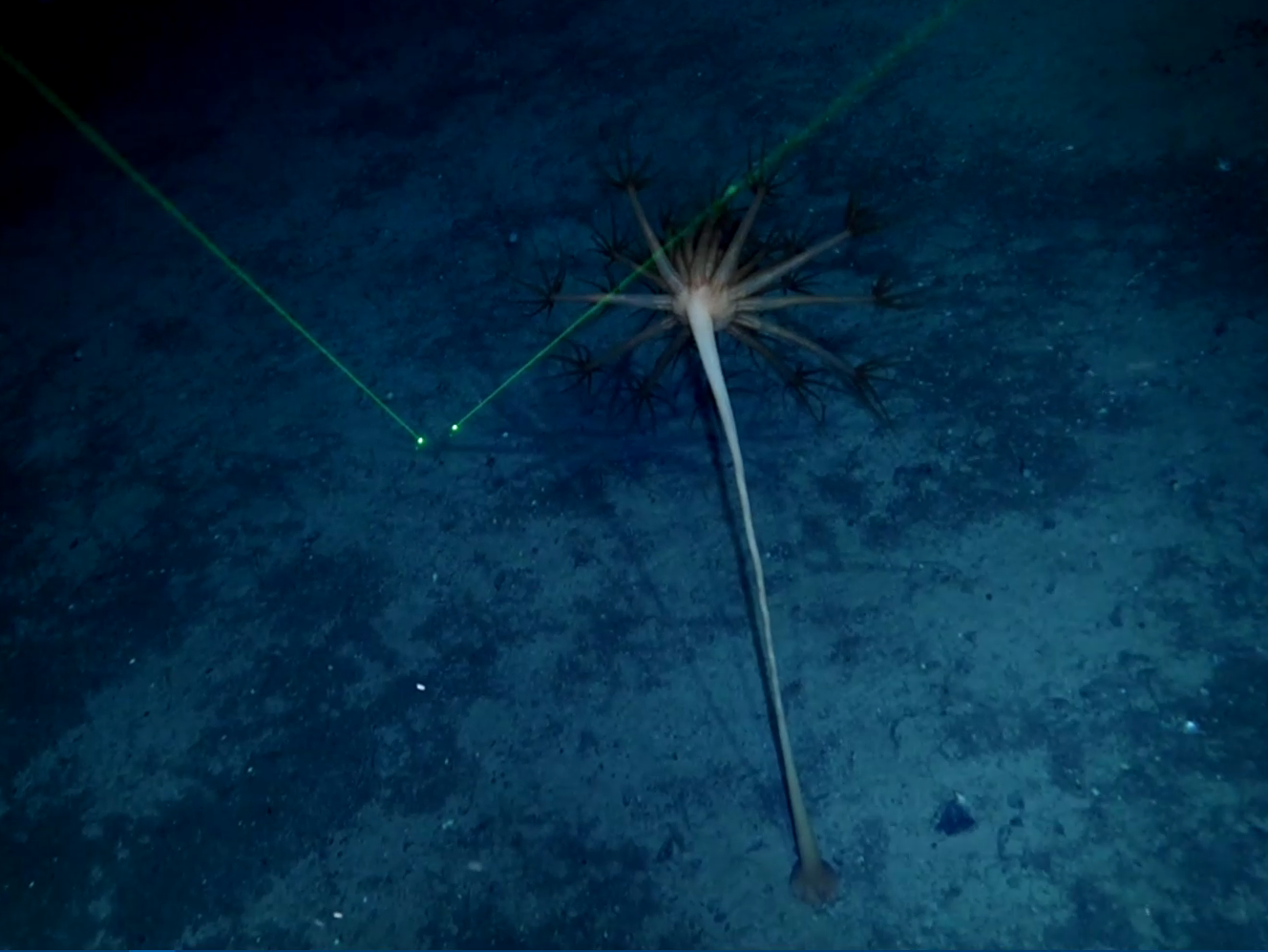
Distance between lasers: 10 cm.
Depth: 1064 m.
Image by: DeepInsight-2023
Taxonomy Summary
- Phylum Cnidaria
- Class Octocorallia
- Order Scleralcyonacea
- Family Umbellulidae
- Genus Umbellula